
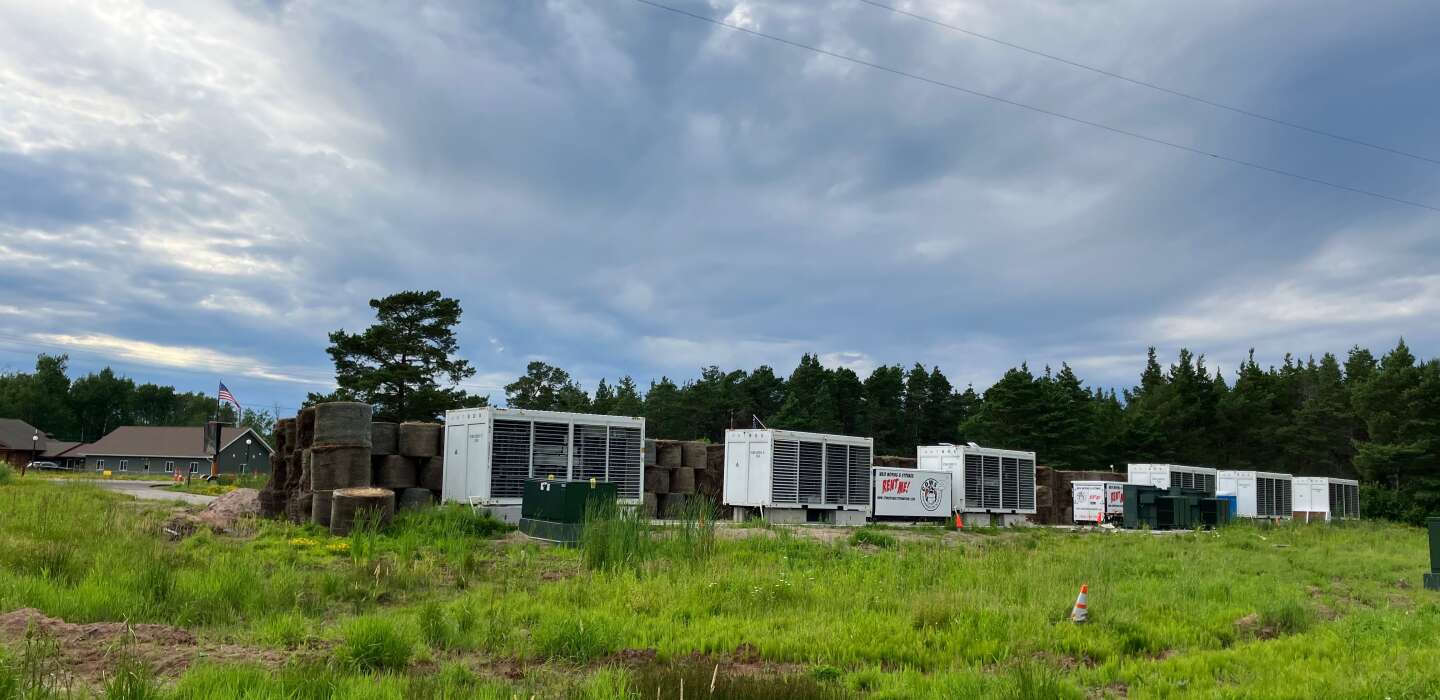
The cryptocurrency mining facility located on Mackinac Trail, approximately seven miles south of Sault Ste. Marie, has been generating a persistent, high-pitched noise reminiscent of mechanical insects. Earlier this year, the noise level was recorded at 75 decibels near Lake Superior Academy’s grounds, comparable to that of a running vacuum cleaner, as reported by the school’s Superintendent Susie Schlehuber. At the school’s entrance, the sound registered at 65 decibels, akin to the hum of a washing machine. This continuous metallic whine began in March and, despite attempts to mitigate it with hay bales, has remained largely unrelenting, aside from a brief two-week halt mandated by a court ruling, according to a lawsuit filed by the school. “It’s 24 hours a day, seven days a week. It never stops,” Schlehuber remarked.
The school, which emphasizes environmental education for its roughly 100 students, has become increasingly aware of the noise since outdoor activities are a significant part of their curriculum. “Because of that we noticed the noise even more so than if we were just a school that stayed inside the classroom with the doors closed,” she explained. As a result, lessons on the front lawn have been abandoned, windows are kept shut, and plans for two additional classrooms have been put on hold.
The cryptocurrency mining operation consists of six self-contained systems managed by Odessa Partners LLC, a company based in Boca Raton, Florida. Legal documents reveal that Odessa Partners is linked to two other entities: the Wyoming Partners Irrevocable Statutory Trust, registered in Cheyenne, and Valletta Corp, LLC, which is based in Delaware. Both firms are associated with Michael Carbonara, a Florida resident who serves as the CEO of Ibanera, a company that positions itself as a “fintech enablement platform and cross-border payments network.” Carbonara, who applied for the necessary building permit for the mining operation, has not responded to inquiries from the media or from Odessa Partners’ legal representatives.
Following a temporary halt ordered by Chippewa County Circuit Court Judge James Lambros last month, Odessa Partners reported in court documents that the shutdown was costing them over $15,000 daily. They claimed to have already implemented noise reduction measures, such as placing hay bales in front of their equipment. The company also pointed out that the school property is adjacent to Interstate 75, arguing that the noise from their operation is less disruptive than the sounds typically associated with traffic on the highway. However, Schlehuber countered, stating, “there’s a huge difference between a loud truck going by a few times a day and constant noise.” She emphasized that the school had attempted to cooperate with Odessa Partners since March but had seen little progress toward a viable resolution. “We knew we had to do something else besides just talk to them,” she stated.
UNDERSTANDING CRYPTOCURRENCY MINING IN NORTHERN MICHIGAN
Cryptocurrency mining utilizes substantial computational resources to generate random numbers, which is essential for verifying transactions in the cryptocurrency ecosystem. Unlike traditional currencies that are issued by governments, cryptocurrencies depend on a public digital ledger to document transactions whenever individuals buy or exchange them. Mining serves as a method of validating these transactions, where miners take unverified transactions and add them to the public ledger, assigning each a unique digital identifier. However, creating a valid identifier is largely a matter of chance and requires extensive computational power. Mining rigs can process millions of potential numbers per second, but the results are determined through complex cryptographic algorithms that produce random outcomes. This process is akin to trying to roll double sixes one thousand times consecutively; the only way to enhance one’s odds is through continuous attempts. Successful miners receive rewards in the form of newly minted cryptocurrency and can also earn from transaction fees.
The energy demands of this process are staggering; for instance, mining a single bitcoin consumes energy equivalent to what an average U.S. household uses over a span of 39 days, according to the Bitcoin Energy Consumption Index. This significant energy requirement makes locations like Sault Ste. Marie appealing for mining operations, according to Kevin Shaw, CEO of OOM Technologies, which currently hosts computers for cryptocurrency mining near the Odessa Partners facility. The region’s cold climate is beneficial since cooling systems can account for up to 40% of a data center’s energy expenditure, and utilizing natural airflow for cooling is the most efficient approach, Shaw noted. However, a more compelling factor for Shaw’s company was the cooperation from the local electrical utility, Cloverland Electric Cooperative, which is keen on accommodating customers that have stable and high power usage, thereby benefiting both the utility and the community.
Schlehuber recalled that the school first learned of the Odessa Partners project last fall when a representative from Cloverland approached them seeking an easement for their property. Upon inquiring for further details, the responses were vague. “We didn’t really understand who was going in, and so, based on that, the board said no,” she reported. Subsequent conversations with workers setting up the site revealed that Cloverland had informed them about the property’s availability. When questioned if Cloverland had a role in directing Odessa Partners to the site, a spokesperson for the utility provided a link to a FAQ that did not address the inquiry. The FAQ, attributed to Cloverland President and CEO Mike Heise, merely stated that the utility has no authority over land-use decisions. It did note that data centers contribute consistent, high-volume energy use, which generates additional revenue, helping to manage system costs and maintain long-term rate stability for all members.
Dafter Township Supervisor Bob Brown has not responded to repeated requests for comments, but he mentioned to WCMU that the controversy surrounding the cryptocurrency mining operation has prompted the township to consider implementing more specific regulations for data centers. Schlehuber expressed her confusion about why Odessa Partners would choose to set up operations directly across from an elementary school, stating, “It makes absolutely no sense.” She speculated that the location was selected due to Cloverland’s outreach regarding available parcels, adding, “It’s like they were looking for a fight.”


